

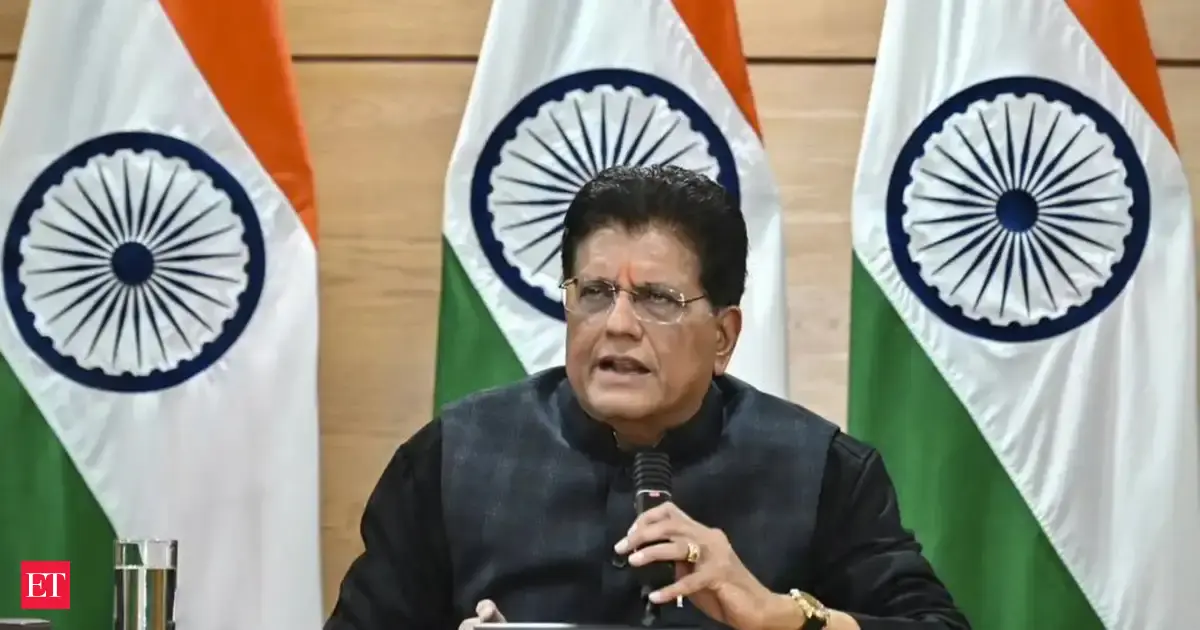
The statement was made by India's Commerce Minister, Piyush Goyal.
GK and monthly revision
Trade deal with US safeguards India’s interests, says Piyush Goyal
India's Commerce Minister Piyush Goyal affirmed that the ongoing trade agreement with the United States is structured to protect the interests of Indian farmers and domestic industries. He highlighted the significant volume of Indian agricultural exports to the US, underscoring the deal's importance. This agreement is crucial for competitive exam preparation as it reflects India's strategic trade policy, its focus on safeguarding domestic sectors, and efforts to boost exports in key markets.
Revision structure
Monthly events and exam calendar context
Static GK and one-liner notes
Quiz and mock-test revision path
Key points
Exam-ready takeaways
The focus of the statement was a trade agreement between India and the United States (US).
The deal includes specific safeguards for Indian farmers, protecting their interests.
Domestic industries in India are also safeguarded under the terms of this trade agreement.
The agreement aims to provide Indian goods with a competitive edge in the American market.
Detailed analysis
Full exam-oriented breakdown
India's Commerce Minister Piyush Goyal's statement regarding the safeguards for farmers and domestic industries within the ongoing trade agreement with the United States underscores a critical aspect of India's contemporary trade policy: balancing global economic integration with the protection of national interests. This approach is particularly significant in the context of India's 'Atmanirbhar Bharat' (Self-Reliant India) initiative, which seeks to bolster domestic manufacturing and agriculture while strategically engaging with the world. **Background Context and Evolution of India-US Trade Relations:** India and the United States share a complex, yet increasingly robust, trade relationship. Historically, trade ties were somewhat limited, but they have evolved significantly, particularly since the early 2000s, transforming into a 'strategic partnership.' Bilateral trade in goods and services reached an impressive USD 128.55 billion in 2022-23, making the US India's largest trading partner. However, this journey has not been without friction. Areas of contention have included intellectual property rights, tariffs on specific products (like steel and aluminum from India, and Harley-Davidson motorcycles from the US), and market access issues. A significant development was the US withdrawal of Generalized System of Preferences (GSP) benefits for Indian exports in June 2019, which impacted various Indian industries by increasing the cost of their exports to the US. **The Current Trade Deal and Minister Goyal's Statement:** Against this backdrop, the current discussions aim to forge a limited trade package, often referred to as a 'mini-deal,' rather than a comprehensive Free Trade Agreement (FTA) at this stage. Minister Goyal's assurance highlights that India is meticulously negotiating terms that specifically include 'safeguards' for its crucial agricultural sector and domestic industries. For farmers, these safeguards could involve protections against a surge of cheaper imports, ensuring minimum support prices are not undermined, or securing preferential access for specific Indian agricultural products like basmati rice, spices, or certain fruits. For domestic industries, safeguards might include calibrated tariff reductions, anti-dumping measures, or rules of origin to prevent circumvention. The goal is to provide Indian goods a 'competitive edge' in the American market, which could translate into lower tariffs for Indian exports or easier market access, ultimately boosting India's export earnings and creating employment opportunities. **Key Stakeholders and Their Interests:** Multiple stakeholders are keenly watching these developments. The **Indian Government** seeks to enhance export growth, attract foreign investment, and integrate India into global supply chains while protecting its vulnerable sectors. **Indian farmers** are a politically significant group whose interests in market access for their produce (like grapes, mangoes, pomegranates, and marine products) and protection from cheaper imports are paramount. **Domestic industries**, including MSMEs, textile manufacturers, and pharmaceutical companies, are looking for better access to the US market while being wary of increased competition from US imports. On the **US side**, the government aims to secure better market access for American products and services (e.g., medical devices, almonds, digital services) and deepen strategic ties. **US businesses and consumers** benefit from increased trade through diversified product offerings and potentially lower prices. **Significance for India:** This trade understanding holds immense significance for India. Economically, it can provide a much-needed boost to India's exports, helping to reduce its trade deficit and stimulate economic growth. It solidifies the US as a key market for India's diverse goods and services. Politically, closer economic ties reinforce the broader India-US strategic partnership, which is vital for regional stability and addressing global challenges. Socially, increased exports and industrial activity can lead to job creation and improved livelihoods, particularly in the agricultural and manufacturing sectors. This deal also reflects India's proactive engagement in shaping its bilateral trade relationships, demonstrating its capacity to negotiate terms that align with its developmental priorities and 'Vocal for Local' ethos. **Constitutional and Policy Framework:** The Indian Constitution empowers the executive and legislative branches to engage in international trade agreements. **Article 253** grants Parliament the power to make any law for implementing any treaty, agreement, or convention with any other country or any decision made at any international conference, association, or other body. This article is crucial for giving legal effect to international trade deals within India. Furthermore, **Article 73** outlines the executive power of the Union, extending to matters with respect to which Parliament has power to make laws, which includes entering into and negotiating international treaties. India's **Foreign Trade Policy (FTP)**, updated periodically (e.g., FTP 2023), serves as the overarching framework guiding these negotiations, aiming to make India a global trading hub and support its export growth targets. These bilateral trade discussions also operate within the broader framework of India's commitments to the **World Trade Organization (WTO)**, ensuring that any deal adheres to multilateral trade rules. **Future Implications:** This limited trade agreement could be a stepping stone towards a more comprehensive Free Trade Agreement (FTA) between India and the US in the future. It allows both nations to build trust and address specific sectoral issues before embarking on a broader agreement. Success in this 'mini-deal' could pave the way for increased foreign direct investment, technology transfer, and deeper collaboration in areas like digital trade and critical minerals. However, challenges remain, including navigating protectionist sentiments in both countries, resolving long-standing issues like non-tariff barriers, and adapting to evolving global trade dynamics, such as the push for resilient supply chains. This strategic engagement will continue to shape India's position in the global economic order.
How to study
Turn news into exam marks
Revise monthly events by exam family instead of reading random updates.
Pair one-liners with mock tests so mistakes become the next revision list.
Keep state job pages, calendar pages and GK packs connected in one path.