

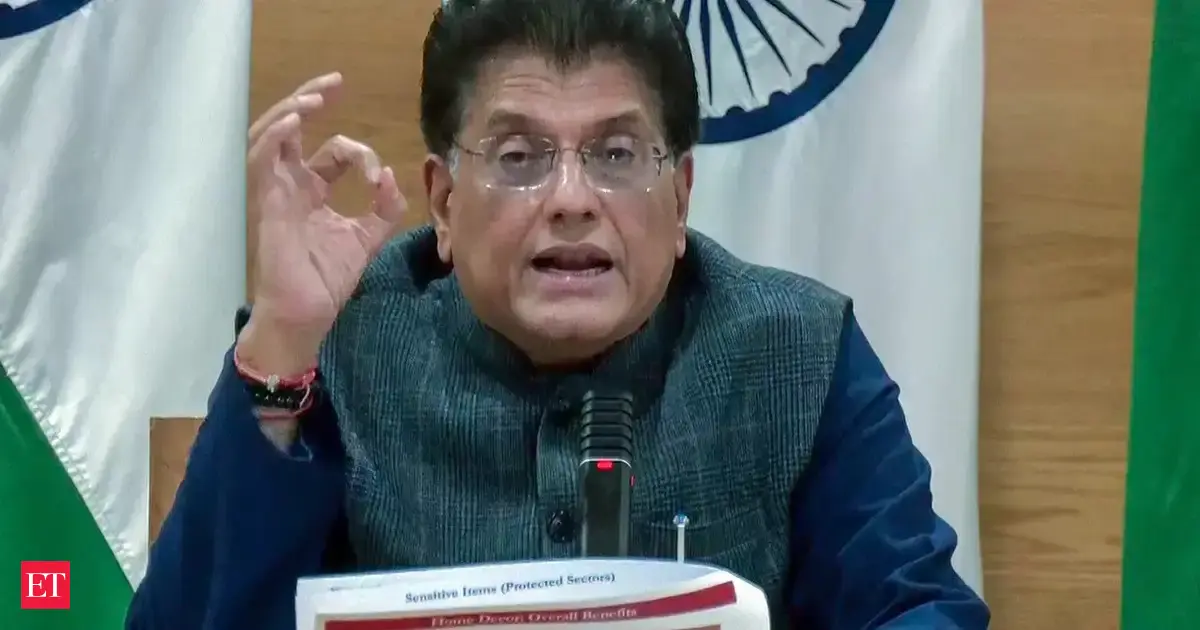
Commerce Minister Piyush Goyal held a meeting with industry leaders and exporters.
GK and monthly revision
Commerce Minister Piyush Goyal to meet exporters, industry on Feb 11
Commerce Minister Piyush Goyal was scheduled to meet industry leaders and exporters on February 11 to discuss the recently finalised trade deals with the United States and the European Union. The meeting aimed to provide clarity on the implementation of these agreements, particularly regarding the US's commitment to reduce tariffs on Indian goods and address exporters' concerns on oil purchase clauses. This development is crucial for understanding India's evolving trade policy and its impact on the economy, making it significant for competitive exam preparation.
Revision structure
Monthly events and exam calendar context
Static GK and one-liner notes
Quiz and mock-test revision path
Key points
Exam-ready takeaways
The meeting took place on February 11.
Discussions focused on the recently finalised trade deals with the United States and the European Union.
The United States has agreed to reduce tariffs on specific Indian goods.
Exporters sought clarity on the implementation of these deals, oil purchase clauses, and the timeline for a final EU agreement.
Detailed analysis
Full exam-oriented breakdown
India's proactive engagement in global trade, marked by Commerce Minister Piyush Goyal's meeting with industry leaders and exporters on February 11, signals a critical juncture in the nation's economic policy. This meeting was pivotal, following the finalisation of trade deals with economic giants like the United States and the European Union, aiming to provide clarity on implementation and future timelines. Understanding this development requires delving into India's trade aspirations, the complexities of international negotiations, and the domestic implications. The **background context** for these trade discussions is rooted in India's persistent efforts to integrate more deeply into the global economy post-1991 liberalisation. Historically, India has sought to diversify its export markets and reduce its reliance on a few partners, while also securing preferential access for its goods. The global trade landscape has shifted from a multilateral focus, championed by the World Trade Organization (WTO), towards a proliferation of bilateral and regional trade agreements (RTAs) and Free Trade Agreements (FTAs). India, too, has adapted its strategy, pursuing such agreements to boost its economic growth and secure its strategic interests. The relationship with the US, a major trading partner, has seen fluctuations, including the US withdrawal of GSP (Generalized System of Preferences) status for India in 2019. Similarly, FTA negotiations with the EU, initiated in 2007, faced prolonged stalemates before a recent re-engagement, reflecting the intricate balance of interests involved. The **meeting on February 11** served as a crucial interface between the government and the industry. The core agenda revolved around the specifics of the recently concluded trade deals. With the US agreeing to reduce tariffs on certain Indian goods, exporters sought detailed clarity on the scope and timeline of this implementation. Furthermore, discussions on 'oil purchase clauses' indicate India's strategic interest in securing energy supplies and managing its import bill, a recurring theme in its trade policy. For the EU agreement, the industry's eagerness for a definitive timeline underscores the potential benefits envisioned from deeper economic ties with one of the world's largest trading blocs. **Key stakeholders** involved in this intricate process are multi-faceted. At the forefront is the **Indian Government**, particularly the Ministry of Commerce and Industry, which acts as the chief negotiator and policy architect. Its role is to secure the best possible terms for India's economy and industries. **Indian Exporters and Industry Leaders** form another vital group; they are the direct beneficiaries or challengers of these agreements and provide crucial feedback on practical implementation issues, market access, and competitive challenges. Their insights are indispensable for shaping effective trade policies. On the international front, the **United States Government** and the **European Union** are critical partners, each with their own economic and geopolitical objectives that intersect with India's. Their willingness to negotiate and commit to preferential trade terms significantly impacts India's export potential and economic trajectory. This development holds immense **significance for India**. Economically, enhanced market access to the US and EU, coupled with reduced tariffs, can significantly boost India's exports across various sectors like textiles, pharmaceuticals, agriculture, and IT services. This aligns perfectly with the 'Make in India' and 'Atmanirbhar Bharat' initiatives, aiming to make India a global manufacturing hub and reduce import dependence. Increased exports can lead to higher foreign exchange earnings, job creation, and overall economic growth. Strategically, strengthening trade ties with major economies like the US and EU enhances India's geopolitical standing, diversifies its supply chains, and reduces vulnerabilities to global economic shocks. Politically, successful trade negotiations project India as a reliable and dynamic global partner, capable of navigating complex international relations. From a **constitutional and policy perspective**, India's engagement in international trade is underpinned by specific provisions. The **Foreign Trade (Development and Regulation) Act, 1992**, empowers the Central Government to make provisions for the development and regulation of foreign trade. The **Constitution of India** grants the Union Executive the power to enter into treaties and agreements with foreign countries (Article 73). Furthermore, **Article 253** empowers Parliament to make laws for implementing any international treaty, agreement, or convention, thereby providing the legislative backing for trade deals. The **Seventh Schedule, Union List (Entry 14)** explicitly mentions "Entering into treaties and agreements with foreign countries and implementing of treaties, agreements and conventions with foreign countries," solidifying the Union's authority in this domain. These constitutional provisions ensure that India's international commitments have a robust legal framework. The **Foreign Trade Policy (FTP)**, periodically revised by the Commerce Ministry (e.g., FTP 2023), serves as the overarching framework guiding India's trade strategy, setting objectives and outlining measures for export promotion and import regulation. The **future implications** of these trade deals are profound. Successful implementation could pave the way for increased foreign direct investment (FDI) into India as businesses seek to leverage preferential access to major markets. It could also spur domestic reforms to enhance competitiveness and ease of doing business. However, challenges remain, including ensuring non-tariff barriers do not negate tariff reductions, addressing domestic industry concerns about increased competition, and effectively resolving trade disputes. India's continued focus will likely be on diversifying its export basket, exploring new markets beyond traditional partners, and negotiating more comprehensive economic partnership agreements. These strategic moves are vital for India to cement its position as a significant player in the evolving global economic order.
How to study
Turn news into exam marks
Revise monthly events by exam family instead of reading random updates.
Pair one-liners with mock tests so mistakes become the next revision list.
Keep state job pages, calendar pages and GK packs connected in one path.