

The Civil Aviation Minister stated that the Hosur airport proposal was not recommended for prioritization.
GK and monthly revision
Hosur airport not recommended to prioritise defence projects of national importance, says Civil Aviation Minister
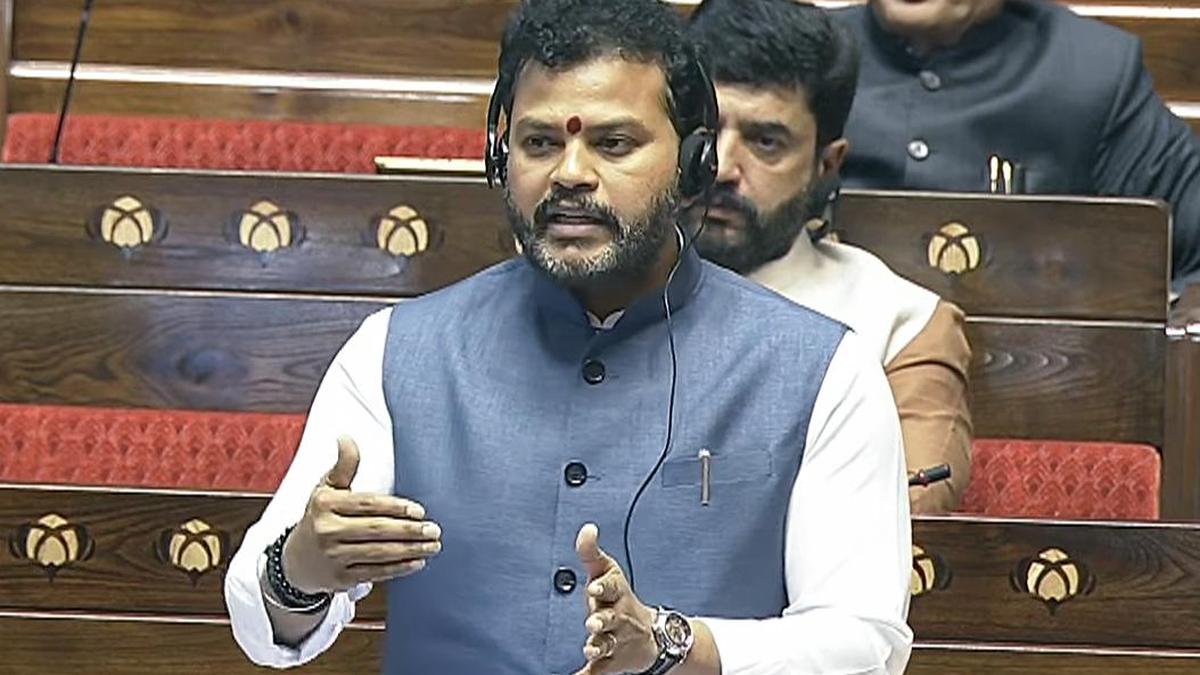
The Civil Aviation Minister stated that the Hosur airport proposal was not recommended for prioritization due to its potential conflict with defence projects of national importance. This decision, conveyed in response to a question by DMK MP S. Kalyanasundaram in the Rajya Sabha, highlights the government's strategic focus on national security over regional civil aviation expansion in specific areas. For competitive exams, it underscores the interplay between civil aviation policy, defence requirements, and parliamentary oversight.
Revision structure
Monthly events and exam calendar context
Static GK and one-liner notes
Quiz and mock-test revision path
Key points
Exam-ready takeaways
The reason for non-prioritization is its conflict with 'defence projects of national importance'.
The statement was made in response to a question raised by DMK MP S. Kalyanasundaram.
The question concerned the delay in granting in-principle approval and airspace clearance for Hosur airport.
The issue was discussed in the Rajya Sabha, highlighting parliamentary accountability.
Detailed analysis
Full exam-oriented breakdown
The statement by the Civil Aviation Minister regarding the non-prioritization of the Hosur airport proposal due to its conflict with 'defence projects of national importance' encapsulates a critical policy dilemma often faced by governments: how to balance developmental aspirations with national security imperatives. This decision, revealed in the Rajya Sabha in response to a question by DMK MP S. Kalyanasundaram, offers a rich case study for understanding governance, federalism, and strategic planning in India. **Background Context and the Hosur Proposal:** Hosur, located in the Krishnagiri district of Tamil Nadu, is a rapidly industrializing town, often referred to as 'Little England' due to its temperate climate and 'The Gateway to Karnataka' due to its proximity to Bengaluru. It hosts major industrial clusters, including automobile, manufacturing, and IT/ITeS companies. The existing Hosur Aerodrome, owned by Taneja Aerospace and Aviation Ltd. (TAAL), currently serves as a private airstrip primarily for testing and general aviation. For years, there has been a persistent demand from the Tamil Nadu government, local industrialists, and the public to upgrade it into a full-fledged commercial airport. This move was seen as crucial for boosting regional economic growth, enhancing connectivity, and decongesting Bengaluru’s Kempegowda International Airport (KIA), which is merely 80 km away. The proposal aimed to bring Hosur under the ambit of the UDAN (Ude Desh ka Aam Naagrik) scheme, which seeks to make air travel affordable and widespread by connecting unserved and underserved airports. **The Minister's Statement and the Defence Imperative:** The core of the issue lies in the Civil Aviation Minister's explicit statement that the proposal was 'not recommended for prioritization' because of its potential conflict with 'defence projects of national importance'. While the specific nature of these defence projects was not elaborated, it is widely understood that the airspace around Bengaluru and its periphery is strategically sensitive. Bengaluru is home to critical defence establishments, including Hindustan Aeronautics Limited (HAL), which manufactures aircraft, and the Yelahanka Air Force Station, a major airbase for transport aircraft and training. The presence of a new commercial airport in Hosur, with its associated air traffic movements, could potentially interfere with military flight paths, training exercises, or future strategic defence initiatives. Airspace management in India involves close coordination between civil and military authorities, with the Ministry of Defence holding significant sway, especially concerning areas deemed vital for national security. **Key Stakeholders Involved:** Several key stakeholders are involved in this decision. The **Ministry of Civil Aviation** is responsible for formulating policies and regulating civil aviation, including airport development. The **Ministry of Defence** prioritizes national security and the operational readiness of its assets. The **Government of Tamil Nadu** is a key proponent, advocating for regional development and improved connectivity. **DMK MP S. Kalyanasundaram** represents the parliamentary oversight mechanism, raising concerns on behalf of his constituents and demanding accountability. The **Airports Authority of India (AAI)**, a statutory body under the Ministry of Civil Aviation, is responsible for creating, upgrading, maintaining, and managing civil aviation infrastructure. Finally, the **local industries and population** in the Hosur-Krishnagiri region are direct beneficiaries or affected parties by such infrastructure decisions. **Significance for India: Balancing Development and Security:** This decision highlights a fundamental aspect of governance in India: the delicate balance between economic development and national security. While regional connectivity and economic growth are vital, as envisioned by schemes like UDAN and the National Civil Aviation Policy, 2016, national security often takes precedence when perceived conflicts arise. This situation underscores the fact that infrastructure projects, especially those involving critical resources like airspace, are not merely economic decisions but also strategic ones. It reflects the government's commitment to safeguarding its defence capabilities, even if it means deferring or altering civil development plans. Moreover, it touches upon Centre-State relations, where a state government's developmental aspirations might be constrained by the central government's national security considerations. **Constitutional and Legal Framework:** The subject of aviation falls primarily under the **Union List** (List I) of the Seventh Schedule of the Indian Constitution. Specifically, **Entry 29** deals with 'Ports, other than those declared by Parliament to be major ports', **Entry 31** with 'Aerodromes', and **Entry 32** with 'Air navigation, including the provision of aids to air navigation and all other matters connected with air traffic'. Defence is also a Union List subject (**Entry 1**). This constitutional framework grants the Central government overarching authority in matters of civil aviation and defence. The **Aircraft Act, 1934**, and the **Airports Authority of India Act, 1994**, provide the legal basis for regulating civil aviation and managing airports. Parliamentary oversight, as demonstrated by the MP's question in the Rajya Sabha, is an essential feature of India's democratic governance, ensuring accountability of the executive branch as per **Articles 75 and 88** of the Constitution. **Future Implications:** The decision on Hosur airport sets a precedent for how future civil aviation projects might be evaluated, especially those proposed near existing or planned defence installations. It signals that defence considerations will remain paramount. For Hosur, this means a continued reliance on Bengaluru for air travel, potentially impacting its full economic potential. However, it might also spur the state government to explore alternative locations for a regional airport that do not conflict with defence interests, or to engage in more detailed negotiations with the Ministry of Defence to find mutually agreeable solutions for airspace sharing. This situation also underscores the need for proactive spatial planning and inter-ministerial coordination from the initial stages of large infrastructure projects to avoid such conflicts. In conclusion, the Hosur airport decision is a nuanced example of national policy-making, where the imperative of national security, a core constitutional duty, has been prioritized over regional civil aviation expansion. It highlights the complexities of governance in a developing nation with significant strategic interests.
How to study
Turn news into exam marks
Revise monthly events by exam family instead of reading random updates.
Pair one-liners with mock tests so mistakes become the next revision list.
Keep state job pages, calendar pages and GK packs connected in one path.