

The event is scheduled for 'Day 9' of the ongoing Parliament Budget Session.
GK and monthly revision
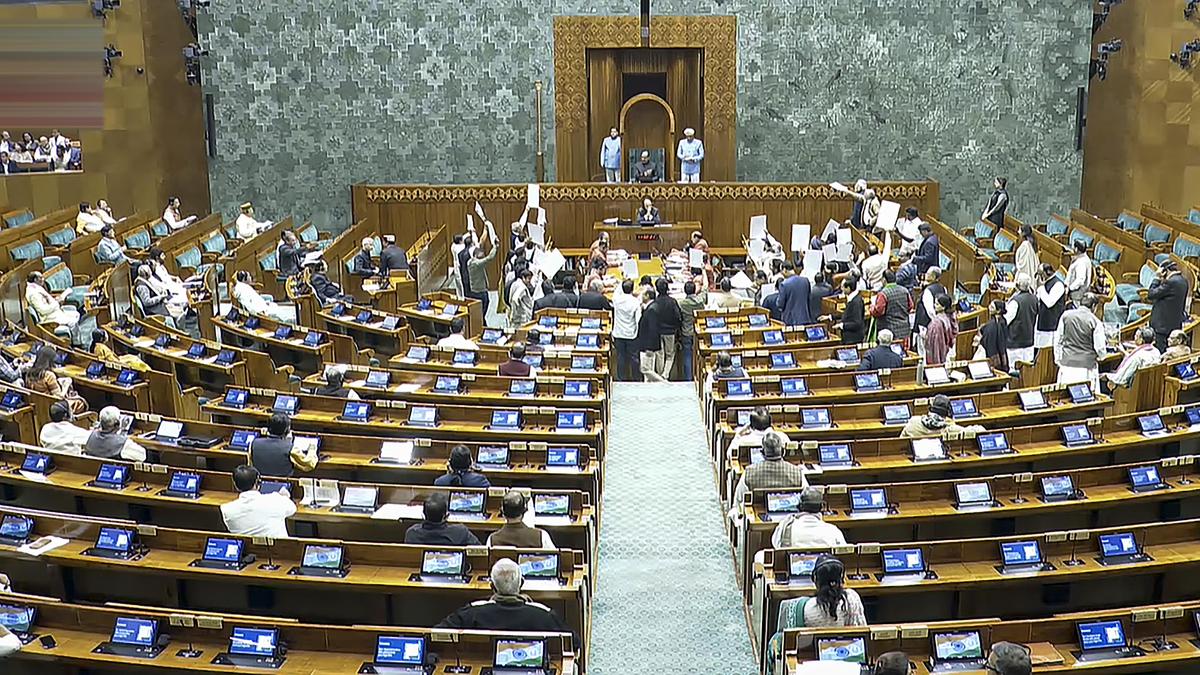
Parliament Budget Session Day 9 LIVE: Both Houses to begin discussion on Union Budget 2026-27
The Parliament's Budget Session is ongoing, with both Houses set to commence discussions on the Union Budget 2026-27 on Day 9. This parliamentary proceeding is crucial for India's financial planning and legislative oversight. Additionally, Opposition MPs are expected to demand a debate on the framework of the Trade Agreement between India and the United States, highlighting the legislature's role in scrutinizing international economic policies.
Revision structure
Monthly events and exam calendar context
Static GK and one-liner notes
Quiz and mock-test revision path
Key points
Exam-ready takeaways
Both Houses of Parliament are slated to begin discussions on the 'Union Budget 2026-27'.
Opposition MPs are expected to demand a discussion on a specific 'Trade Agreement'.
The trade agreement in question is between 'India and the United States'.
The discussion on the Union Budget is a key legislative process for the financial year '2026-27'.
Detailed analysis
Full exam-oriented breakdown
The news regarding Day 9 of the Parliament Budget Session, focusing on the Union Budget 2026-27 and the Opposition's demand for a discussion on the India-US Trade Agreement framework, encapsulates critical aspects of India's governance, economic policy, and international relations. This event serves as a microcosm of parliamentary democracy in action, where the Executive's financial and foreign policy initiatives are subjected to legislative scrutiny. **Background Context and What Happened:** The Parliament Budget Session is an annual fixture, typically running from late January/early February to May, divided into two phases. It is constitutionally mandated for the government to present the Annual Financial Statement, commonly known as the Union Budget, before both Houses. The budget outlines the government's estimated receipts and expenditures for the upcoming financial year, which in this case is 2026-27. The process involves several stages: presentation, general discussion, scrutiny by Departmentally Related Standing Committees, voting on Demands for Grants, and finally, the passing of the Appropriation Bill and the Finance Bill. This elaborate procedure ensures parliamentary control over the Executive's financial powers. On Day 9, the Houses are set to begin the crucial general discussion phase, allowing MPs to debate the overall economic policies and proposals contained within the budget. Simultaneously, the Opposition's demand for a discussion on the framework of the Trade Agreement between India and the United States highlights the legislature's role in scrutinizing international economic policies. India and the US have been progressively deepening their strategic and economic partnership, with bilateral trade reaching significant figures. Discussions around a comprehensive trade agreement have been ongoing for several years, aiming to reduce tariffs, address non-tariff barriers, and enhance market access across various sectors. The Opposition's intent to debate its framework indicates concerns possibly related to its potential impact on domestic industries, agricultural sector, intellectual property rights, or the overall terms of engagement. **Key Stakeholders Involved:** 1. **The Government (Executive):** Primarily the Ministry of Finance, which prepares and presents the Union Budget, and the Ministry of Commerce and Industry, which negotiates trade agreements. They are responsible for implementing the budget provisions and the terms of any trade agreement. 2. **The Parliament (Legislature):** Comprising the Lok Sabha (House of the People) and the Rajya Sabha (Council of States), it is the primary forum for debating and approving the budget. Opposition MPs, a crucial part of the Parliament, play the role of holding the government accountable, raising public concerns, and offering alternative perspectives. 3. **Citizens and Businesses:** Ultimately, the beneficiaries or affected parties of both the budget and trade policies. The budget impacts tax rates, government spending on welfare schemes, infrastructure, and subsidies, directly affecting livelihoods and business environments. Trade agreements influence market access, competition, and consumer prices. 4. **The United States:** As the other party to the trade agreement, its economic and strategic interests are intertwined with the outcome of these negotiations. **Why This Matters for India and Broader Themes:** The discussion on the Union Budget 2026-27 is paramount as it dictates India's economic trajectory. It reflects the government's priorities in areas like economic growth, fiscal consolidation, social welfare, and infrastructure development. The budget is a tool for resource allocation, wealth distribution, and macroeconomic management. Its approval is a constitutional necessity for the government to draw funds from the Consolidated Fund of India. The proposed debate on the India-US Trade Agreement framework is significant because the US is one of India's largest trading partners. A robust trade agreement could unlock immense economic potential, boost exports, attract foreign investment, and integrate India further into global supply chains. However, it also carries potential challenges, such as increased competition for domestic industries, especially MSMEs, and concerns over specific sector-wise implications. This debate aligns with broader themes of India's foreign policy, economic liberalization, and its strategic alignment with major global powers. **Historical Context:** The tradition of presenting a Union Budget dates back to colonial times, with the first budget presented in India in 1860. Post-independence, the process was enshrined in the Constitution. Over the decades, budget-making has evolved, becoming more sophisticated with economic planning and reforms. Similarly, India's trade policy has shifted significantly, from a largely protectionist regime post-independence to a more liberalized, open economy following the 1991 reforms. Bilateral trade agreements have become a cornerstone of India's foreign trade strategy, alongside multilateral engagements. **Future Implications:** The outcome of the budget discussions will determine the government's financial roadmap for 2026-27, impacting various sectors and the overall economy. The parliamentary debate on the India-US Trade Agreement framework could either pave the way for its swift finalization or lead to further negotiations and adjustments based on legislative concerns. This scrutiny is vital for ensuring that any international agreement serves India's national interest comprehensively. It reinforces the principle of parliamentary sovereignty and democratic accountability in foreign policy decisions. The session also sets a precedent for how extensively future trade agreements might be scrutinized by the Indian Parliament. **Related Constitutional Articles, Acts, or Policies:** 1. **Article 112 (Annual Financial Statement):** Mandates the President to lay before both Houses of Parliament an annual financial statement of the estimated receipts and expenditures of the Government of India for that financial year. 2. **Article 113 (Procedure in Parliament with respect to estimates):** Deals with the estimates of expenditure presented to the Lok Sabha in the form of Demands for Grants. 3. **Article 114 (Appropriation Bills):** States that no money shall be withdrawn from the Consolidated Fund of India except under appropriation made by law passed in accordance with the provisions of this article. 4. **Article 110 (Money Bills):** Defines what constitutes a Money Bill, under which the Appropriation Bill and Finance Bill are passed, giving the Lok Sabha overriding powers. 5. **Article 265 (Taxes not to be imposed save by authority of law):** No tax shall be levied or collected except by authority of law. 6. **Article 266 (Consolidated Fund and Public Account of India):** All revenues received by the Government of India, all loans raised by that Government by the issue of treasury bills, loans or ways and means advances and all moneys received by it in repayment of loans shall form one consolidated fund. 7. **Fiscal Responsibility and Budget Management (FRBM) Act, 2003:** Aims to ensure fiscal discipline, reduce fiscal deficit, and improve macroeconomic management. 8. **Article 73 (Extent of executive power of the Union):** While not explicitly for treaties, it broadly covers the executive's power to enter into agreements, subject to parliamentary laws. Parliamentary oversight over international treaties is generally exercised through discussions and debates, rather than direct ratification like in some other countries.
How to study
Turn news into exam marks
Revise monthly events by exam family instead of reading random updates.
Pair one-liners with mock tests so mistakes become the next revision list.
Keep state job pages, calendar pages and GK packs connected in one path.